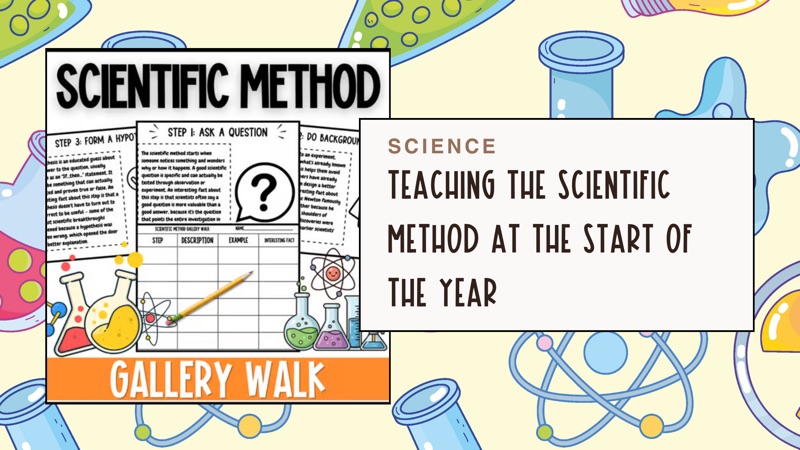
This free scientific method activity for middle schoolers is an easy way to begin the school year with a lesson that gets students reading, moving, and thinking. Along with the free gallery walk, you will find five engaging ways to review the scientific method before students begin conducting experiments and investigations.
The scientific method is usually one of the first topics covered in science class, and for good reason. Students will use these skills throughout the year whenever they ask questions, form hypotheses, collect data, or draw conclusions.
The problem is that many students have already heard the steps several times. They may even be able to recite them in order without really understanding how scientists use them.
Instead of beginning the year with another set of notes, I like to introduce the scientific method through questions, movement, and simple investigations. The goal is not just for students to memorize the steps. I want them to understand how each step helps us answer a question using evidence.
Here are five engaging scientific method activities for grades 4-8 that work especially well at the beginning of the school year.
1. Begin With an Everyday Mystery
Before introducing any vocabulary, give students a simple mystery to solve.
You might show them two plants and ask why one is growing better than the other. You could place a melting ice cube at the front of the room and ask what might make it melt faster. Even a question like “Why do some pencils break more easily than others?” can lead to a good discussion.
Ask students what they would need to know before they could answer the question confidently.
At first, they may start guessing. That is completely fine. Their guesses give you a natural way to explain the difference between an opinion and a testable hypothesis.
Continue asking questions. How could we test that idea? What should stay the same during the test? What information would we record? How would we decide whether the results supported our original thinking?
Students will begin working through the scientific method before you ever give them the names of the steps. Once the formal vocabulary is introduced, it feels connected to a problem they have already considered.
2. Use a Free Scientific Method Gallery Walk
The scientific method includes several connected steps, and introducing all of them through one long lecture can be a rough way to begin the year. Students are still adjusting to new schedules, new teachers, and the idea of sitting still for an entire class period again.
A gallery walk breaks the information into smaller pieces and gets students out of their seats.
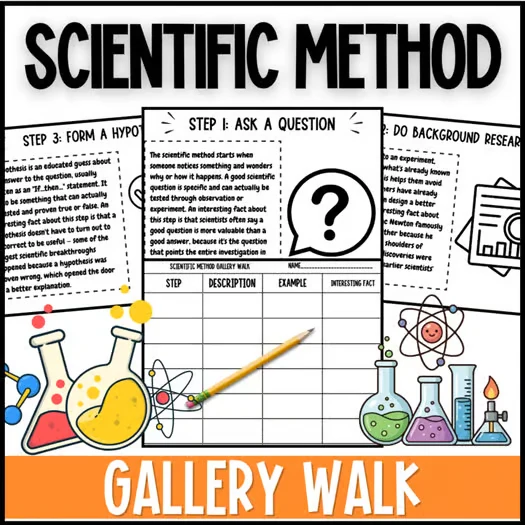
This free Scientific Method Gallery Walk includes six reading stations that introduce the steps of the scientific method. Students move around the classroom and record each step’s description, an example, and an interesting fact. The resource also includes a student answer sheet and answer key, making it an easy, low-prep science activity for grades 3-8.
Get the Free Scientific Method Gallery Walk on TPT
Gallery walks work especially well during the first few days of school because they teach more than content. Students also practice moving between stations, sharing materials, working with a partner, and using an appropriate voice level.
You get to observe how students interact without putting them through another round of classroom procedure slides. They are learning the routines while actually doing science.
After the gallery walk, bring the class together and discuss how the steps connect. Ask students what might happen if a scientist skipped one of the steps or changed several parts of an experiment at once.
This helps students see the scientific method as a complete process rather than six unrelated vocabulary terms.
3. Let Students Fix a Bad Experiment
Students love pointing out when someone else has done something incorrectly. You might as well use that enthusiasm for science.
Give students an example of a poorly designed experiment. It could be something simple, such as a student trying to determine which paper towel absorbs the most water.
In the flawed experiment, the student uses different amounts of water for each brand, tests one paper towel twice but another only once, and decides which brand is best without recording any measurements.
Ask students whether the results would be trustworthy and why.
They will usually spot the major problems quickly. From there, have them explain how they would improve the investigation. What should remain the same? What should be measured? How many times should the test be repeated?
This is a great way to introduce variables, controlled testing, and reliable data without turning the lesson into a page of definitions.
You can also have students work in pairs to rewrite the experiment. Their improved version should clearly explain what they would change and how those changes would produce more useful results.
4. Conduct a Simple Class Investigation
Students do not need an elaborate lab to practice the scientific method.
Choose a question that can be investigated with materials already in your classroom. Students might test which type of paper makes the strongest bridge, whether the length of a paper airplane affects its flight, or which surface creates the most friction.
Work through the investigation as a class the first time.
Begin with the question and allow students to share possible hypotheses. Discuss what needs to remain the same so the test is fair. Decide what data the class will collect and how it will be recorded.
The testing portion is usually the part students remember, but do not rush through the conclusion. Ask them what the results actually show. Did the evidence support the hypothesis? Were there any problems with the test? What would they change if they repeated it?
Students sometimes believe that a hypothesis must be correct for an experiment to be successful. This is a good time to clear that up.
A hypothesis that is not supported by the evidence is not a failed experiment. The results still taught us something. Scientists use unexpected results to ask new questions and design better investigations.
That is an important lesson to establish at the beginning of the year. It also connects naturally with these engineering design process activities, which help students use testing results to improve a solution.
5. Connect the Scientific Method to Real Life
The scientific method can feel like a school-only concept when it is presented as a list students need to memorize for a quiz.
In reality, people use parts of the process all the time.
Imagine that your phone is not charging. You might ask what is causing the problem, consider several explanations, test a different cable, observe what happens, and use the result to decide what to try next.
A student trying to improve a basketball shot might change one part of their technique, practice several times, and compare the results. Someone baking cookies may adjust the cooking time after the first batch comes out too soft.
These are not formal laboratory experiments, but they use the same kind of thinking.
Have students come up with an everyday problem and explain how they could use the scientific method to investigate it. They might choose a question about sports, cooking, pets, plants, video games, or something in the classroom.
The questions do not have to become actual experiments. The point is to help students recognize that scientific thinking begins with curiosity and evidence.
Keep the Scientific Method Visible All Year
Once the introductory lesson is over, the scientific method should not disappear until test review.
Keep the steps displayed somewhere students can see them. Return to the process whenever the class conducts an experiment, reads about a scientific investigation, or evaluates evidence.
You can also refer back to the free gallery walk stations later in the year. The station pages can be displayed as classroom references, placed at a science center, or used for a quick review before students begin a larger investigation.
For a more active test review, reuse the station questions with these Trashketball rules for the classroom. Correct answers earn shots and bonus points, so every team has a reason to keep working through the science.
Over time, students should begin using the language of the scientific method more naturally. Instead of saying, “We did the experiment,” they can explain what they tested, what data they collected, and whether the evidence supported their hypothesis.
That shift takes practice. One lesson will not do everything, but a clear and engaging introduction gives students a strong place to begin.
Start the Year With Scientific Thinking
Teaching the scientific method at the beginning of the year is about more than preparing students for their first experiment. It helps establish the kind of thinking you want students to use throughout science class.
Students learn to ask questions, look for evidence, test ideas, and change their thinking when the results point in a different direction.
A classroom mystery, a flawed experiment, and a simple investigation can all make the process more meaningful. The free Scientific Method Gallery Walk gives you an easy place to start, with six ready-to-use stations that introduce the process without another long lecture.
Download the Free Scientific Method Activity
It is free, low-prep, and ready to print, which is exactly the kind of science activity I want during the first week of school.