Finding engaging 13 Colonies activities for 4th grade can be a little tricky. Fourth graders have a lot to learn: thirteen individual colonies, three colonial regions, several early settlements, and all the different reasons people came to North America in the first place.
That is a lot of information for elementary students to keep straight.
I have found that the 13 Colonies unit works best when students have several different ways to interact with the content. They need maps and direct instruction, of course, but they also need opportunities to imagine colonial life, make decisions, compare regions, and write from different historical perspectives.
Here are six simple ways to make your Colonial America unit more engaging without adding a mountain of prep work.
1. Sort the 13 Colonies by Region
Before students can understand how the colonies developed, they need to know where each colony was located.
Start by dividing the colonies into the New England, Middle, and Southern regions. Students can sort colony names under the correct regional headings and then add one important fact about each area.
The sorting portion is fairly simple, but the real learning comes from discussing why the regions were different. Geography affected nearly every part of colonial life. Climate, soil, waterways, and natural resources all influenced the types of jobs people had and the products each region produced.
Rather than asking students to memorize three separate lists, keep returning to the connection between geography and daily life.
Why did shipbuilding become important in New England? Why was farming more successful in the Southern Colonies? Why were the Middle Colonies sometimes called the “breadbasket”?
When students understand those connections, the regions become much easier to remember. If students need a geography refresher first, these beginning-of-the-year map skills activities review map types, directions, legends, and coordinates.
2. Turn Early Settlements Into News Stories
Jamestown, Plymouth, and Massachusetts Bay can begin to blend together for students. They may remember a few familiar names, but they often struggle to explain why each settlement was founded or why it mattered.
A colonial news report is a fun way to slow down and focus on one settlement at a time.
Have students pretend they are reporters living during the colonial period. Their report should explain where the settlement was located, why people came, one problem the settlers faced, and why the settlement became important.
Students can even give their articles an old-fashioned newspaper headline.
This activity works because students are still practicing informational writing, but the reporter angle makes it feel different from a traditional paragraph or worksheet. It also helps them organize the information around the questions a real reporter might ask: Who was involved? What happened? Where did it happen? Why did it matter?
You can use the reports as a quick writing assignment, allow students to read them aloud, or display them together as a colonial newspaper.
3. Give Students Choices During the Unit
Choice boards are one of my favorite ways to add a little student independence without completely giving up control of the lesson.
Students like being able to choose how they show what they know, and teachers still get meaningful work connected to the content. It is also an easy way to meet different interests in the same classroom. One student may enjoy writing a diary entry, while another would rather organize information or solve a problem.
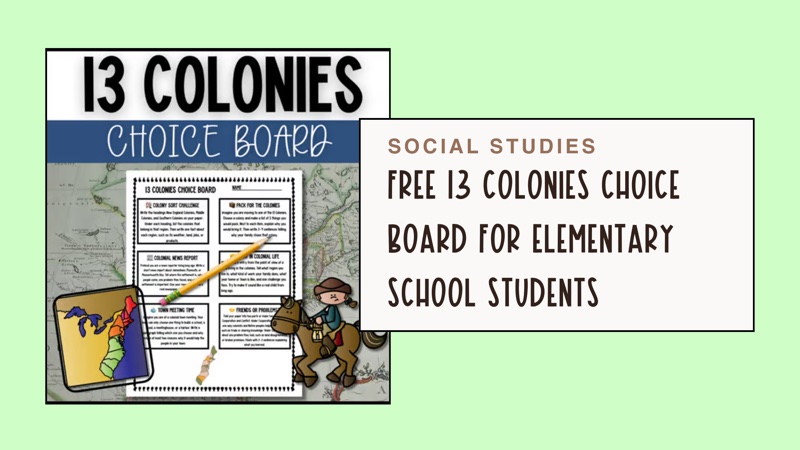
This free 13 Colonies Choice Board for 3rd and 4th grade includes six independent social studies activities. Students can sort the colonies by region, write a colonial news report, participate in an imaginary town meeting, pack for a move to the colonies, write about a day in colonial life, or examine cooperation and conflict between colonists and Native peoples.
The activities require only paper, a pencil, and basic classroom resources, so students are not being asked to build a miniature Jamestown settlement out of craft sticks the night before it is due. That is a win for teachers and families.
You can assign one activity to the entire class, allow students to choose two or three, or keep the choice board available for early finishers and review. It also works well for homework, centers, sub plans, or the final few days of a 13 Colonies unit.
Get the Free 13 Colonies Choice Board on TPT
4. Hold a Colonial Town Meeting
Students often hear that town meetings were an early form of self-government, but that phrase can feel pretty abstract to an eight- or nine-year-old.
Give students a decision that a colonial town might have faced.
For example, imagine that the town has enough money and workers to build only one new structure. Should it build a school, a road, a meetinghouse, or a harbor?
Students must choose one option and explain why it would be the most helpful to the community.
This leads to great conversations because there is no perfect choice. A harbor could improve trade. A road might help people travel and transport goods. A school could help educate children. A meetinghouse could give residents a place to gather and make decisions.
Students begin to understand that communities have limited resources and that self-government involves listening, debating, and making choices that affect everyone.
You can keep this as an independent writing activity or turn it into a full class discussion. Let students share their arguments, hold a vote, and then talk about whether the most popular decision was necessarily the best one.
5. Explore Daily Life Through Historical Writing
Colonial life becomes much more memorable when students imagine what an ordinary day might have looked like.
Have students write a diary entry from the point of view of a child living in one of the colonies. They can describe the region, their family’s work, their home or town, and a challenge they might have faced.
The challenge is where the writing usually becomes interesting.
A child in New England might describe a long, cold winter. A child in a farming family may have chores that begin early in the morning. Someone living in a new settlement might worry about food, illness, or conflict.
Before students write, talk about the difference between using historical facts and simply making things up. Their character can be fictional, but the details should make sense for the time and place.
This is also a good opportunity to discuss how childhood was different during the colonial period. Children often worked alongside their families and had responsibilities that many modern students would consider adult jobs.
Historical diary entries help students practice point of view while showing that history was lived by regular people, not only famous leaders whose names appear in textbooks.
6. Teach Cooperation and Conflict Honestly
Relationships between colonists and Native peoples are sometimes taught as either completely peaceful or completely violent. The real history was much more complicated.
Students should understand that Native peoples and colonists sometimes cooperated through trade, shared knowledge, military alliances, and treaties. They should also learn that there were serious conflicts involving land, broken agreements, expanding settlements, and cultural differences.
A simple comparison activity can help students organize both sides of the story.
Have students divide a sheet of paper into two sections labeled “Cooperation” and “Conflict.” Under each heading, they can record an example and then explain what the examples reveal about the relationship between the groups.
The goal is not to overwhelm elementary students with every detail of colonization. It is to help them recognize that historical relationships can be complicated. Two groups can cooperate in some situations while also experiencing serious disagreements and injustice.
That is an important historical thinking skill that students will continue using long after the 13 Colonies unit is over.
Bring the 13 Colonies Together
The hardest part of teaching the 13 Colonies is helping students see how all the pieces connect.
The colonies were not thirteen identical settlements lined up neatly along the Atlantic coast. Each region had its own geography, economy, religious influences, political practices, and relationships with Native peoples. At the same time, the colonies shared experiences that eventually helped shape the development of the United States.
Activities such as regional sorting, historical news reports, town meetings, diary entries, and comparison writing give students time to make those connections.
They also give you more options than another day of reading the textbook and answering questions.
The free 13 Colonies Choice Board puts all six activities together on one printable page. It is an easy resource to keep on hand when students need independent practice, a meaningful early-finisher task, or a new way to review Colonial America.
Download the Free Choice Board on TPT
Sometimes the simplest activities lead to the best conversations, and anything that gets students thinking deeply without requiring three bags of supplies is worth keeping.