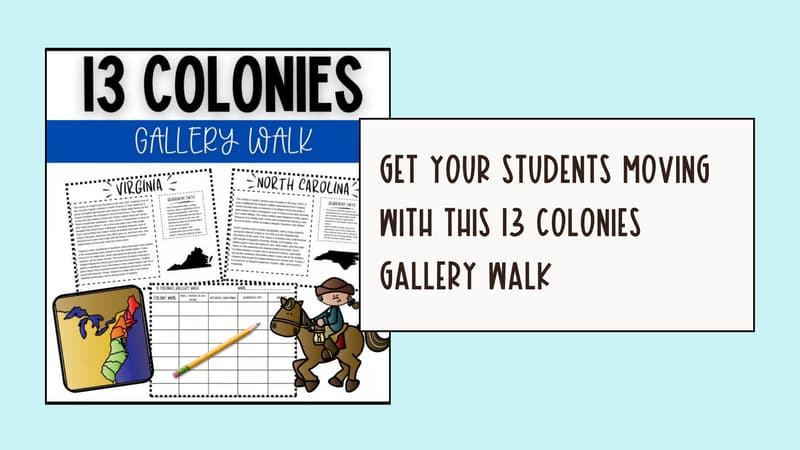
A 13 Colonies gallery walk is an easy way to teach Colonial America without turning the unit into thirteen separate lectures. This 13 Colonies gallery walk gets students moving, reading, and organizing information while helping them understand what made each colony unique.
Teaching all thirteen colonies can get overwhelming fast. Students have to remember names, dates, regions, geography, important people, and reasons for settlement. Before long, Massachusetts starts blending into Maryland, and everyone is ready to move on.
That is why I created this 13 Colonies Gallery Walk.
Shop the 13 Colonies Gallery Walk on TPT
Giving Every Colony Its Own Station
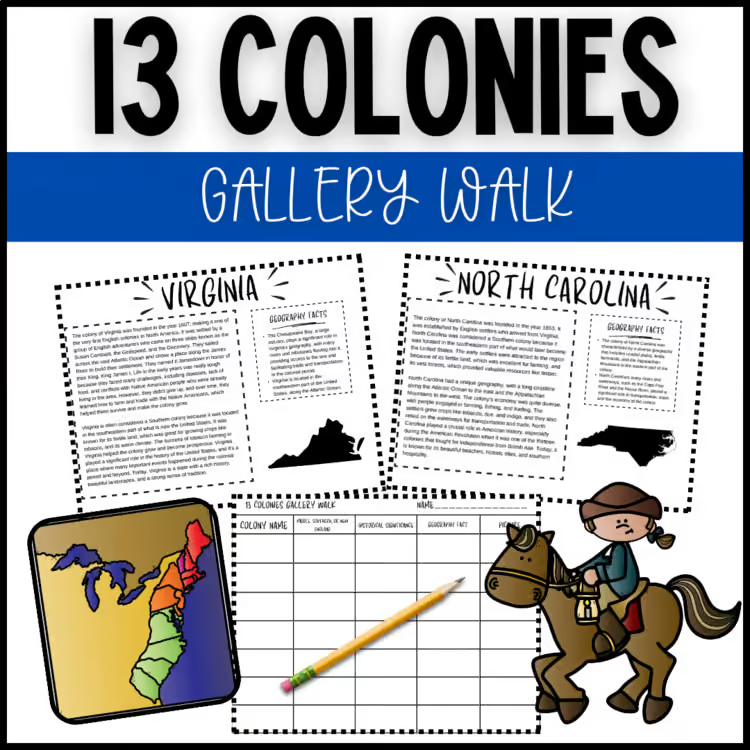
Each colony has its own reading station, so students can focus on one place at a time. They learn when the colony was founded, how it began, which colonial region it belonged to, and why its geography mattered.
Students also see a map of each colony and read additional geography facts. As they rotate around the room, they record the colony’s region, historical significance, and an important geographic detail on the included answer sheet.
Breaking the information into separate stations makes the thirteen colonies feel much more manageable. Instead of staring at one giant chart, students build their understanding one colony at a time.
Helping Students Make Connections
I do not want students to finish a Colonial America unit knowing only that Virginia had Jamestown and Massachusetts had the Pilgrims.
I want them to understand why the colonies developed differently.
Geography influenced farming, trade, transportation, and daily life. Rivers and harbors helped colonies grow. Climate and soil affected which crops could be produced. Religious beliefs, business opportunities, and the hope for a new beginning shaped why people settled in different places.
The gallery walk helps students notice those connections naturally.
They can see how Pennsylvania’s fertile farmland supported grain production, how New York’s harbor encouraged trade, and how Virginia’s waterways helped Jamestown and the tobacco economy grow.
The colonies stop feeling like thirteen random names and begin to feel like thirteen different communities. For more ways to build those connections, these 13 Colonies activities for 4th grade include regional sorting, historical writing, a town meeting, and a free choice board.
Movement With a Clear Purpose
Gallery walks are a great way to add movement to social studies, but students still need a clear task.
The recording pages ask students to identify each colony, sort it into the New England, Middle, or Southern region, summarize its historical importance, record a geography fact, and add a small picture.
That structure keeps students focused while still giving them a break from sitting in one place.
The stations can be completed independently, with partners, or across two class periods. I usually like the partner option because students can discuss what they are reading while still completing their own answer sheets.
Making the 13 Colonies Easier to Remember
By the end of the activity, students have created an organized reference covering all thirteen colonies and the three colonial regions.
More importantly, they understand that the colonies were not all the same. They had different beginnings, different geography, and different reasons for growing.
That foundation makes later lessons about the American Revolution much easier. The colonies are no longer just a list students memorized for a quiz. They are places students have actually studied and compared.
The 13 Colonies Gallery Walk gives students a chance to move, read, and make those connections for themselves.
And it gives teachers one less lesson to plan from scratch.