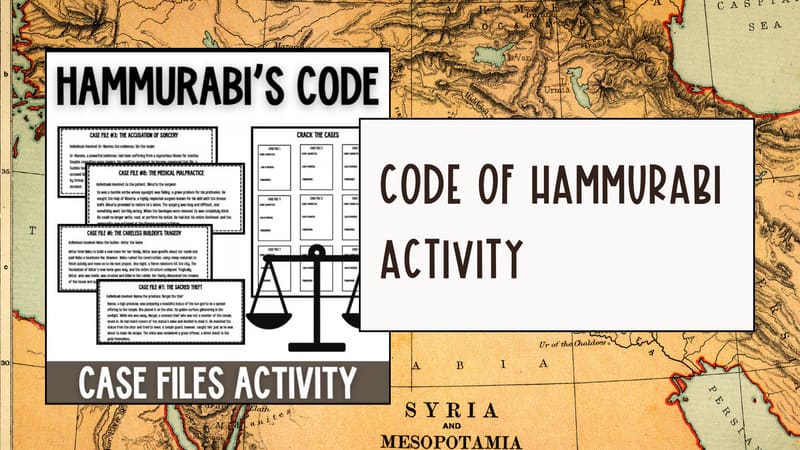
Looking for a Code of Hammurabi activity that goes beyond reading a list of ancient laws? This activity turns Hammurabi’s Code into a series of case files that students must investigate and solve.
Instead of simply being told that Hammurabi’s laws were strict, students get to see those laws in action. They read each case, identify the crime, locate the law that was broken, and determine the punishment Hammurabi’s Code would require.
It is part history lesson, part reading activity, and part ancient courtroom drama, which is usually a pretty good combination for middle school students.
Explore the Hammurabi Case Files on TPT
A Code of Hammurabi Activity Students Actually Want to Complete
Hammurabi’s Code is one of those topics that already has everything students find interesting. It includes crime, punishment, mysteries, arguments, unfair decisions, and laws that can sound completely unbelievable today.
The problem is that the topic often gets reduced to a few vocabulary words and the phrase “an eye for an eye.”
Students might read several laws, answer a few questions, and move on without ever thinking deeply about what those laws reveal about Babylonian society.
The Hammurabi’s Code Case Files Activity changes that by putting students in the role of ancient judges. They are not just reading laws. They are using evidence from those laws to settle actual cases.
That small change makes a huge difference.
How the Hammurabi Case Files Work
Students begin with a collection of laws from Hammurabi’s Code. The laws are organized into categories covering law and order, property and theft, professional responsibility, and injury and justice. The activity includes laws involving builders, surgeons, theft, false accusations, family relationships, and physical injuries.
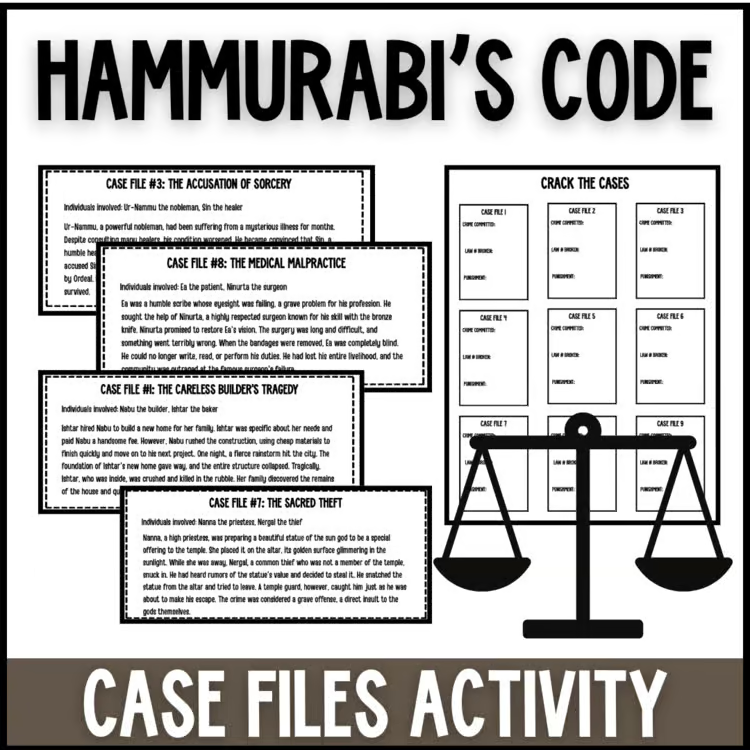
Students then work through nine case files based on situations that might have occurred in ancient Babylon.
One case involves a careless builder whose poorly constructed house collapses. Another involves an accusation of sorcery. Students also investigate a home break-in, a theft during a fire, damage caused by a builder, an injury to an enslaved person, and a crime committed inside a temple.
For each case, students must determine three things: the crime that was committed, the law that applies, and the punishment required by Hammurabi’s Code.
They record their decisions on the included “Crack the Cases” answer sheet. The case files can be handed directly to students or placed around the classroom as a gallery walk.
I especially like the gallery walk option because it gets students moving while keeping them focused on the reading. Partners can rotate from case to case, discuss the evidence, and compare their interpretation of the law before writing their answers.
Shop the Case Files Activity on TPT
Students Have to Read Closely
This Code of Hammurabi activity is engaging, but it is not just a fun break from the textbook.
Students have to read each case carefully enough to identify the important details. A builder whose house kills the owner is treated differently from a builder whose work damages a neighbor’s property. Theft from a temple is treated differently from breaking into someone’s home.
Those differences matter.
Students cannot simply scan the law sheet for a familiar word and guess. They have to compare the facts of the case with the wording of several laws and decide which one fits best.
That makes the activity a natural way to practice close reading, using text evidence, and applying information to a new situation.
It also gives students a reason to reread. They are not going back through the text because the teacher told them to check their work. They are going back because they genuinely want to crack the case.
Hammurabi’s Laws Lead to Great Discussions
The best part of this activity may be the conversation that happens afterward.
Students are usually shocked by the punishments. Many of the crimes result in death or serious physical consequences, while others require fines or repayment. They quickly notice that the punishment is not always based only on the crime.
A person’s social position also matters.
For example, Hammurabi’s Code treats an injury to a free man differently from an injury to an enslaved person. One law requires equal physical punishment, while another requires payment to the enslaved person’s owner.
That opens the door to a much deeper discussion about fairness.
Were Hammurabi’s laws fair because they were written down and applied consistently? Or were they unfair because different groups of people received different treatment?
Students may not agree, and that is exactly what makes the discussion valuable.
They begin to understand that a written legal system can bring order to a society while still reflecting the inequalities and values of that society. That is a much more meaningful takeaway than simply memorizing that Hammurabi was a Babylonian king who created an early law code.
An Easy Addition to an Ancient Mesopotamia Unit
The Hammurabi’s Code Case Files can be used after students receive a basic introduction to Hammurabi and ancient Babylon.
It works well as a partner activity, small-group investigation, classroom gallery walk, or independent assignment. You could also complete one case together as a class before releasing students to solve the remaining cases.
Once everyone has finished, review the cases and allow students to explain their reasoning. I would not rush through this part. Students often have strong reactions to the punishments, and those reactions lead naturally into conversations about justice, social class, government authority, and the purpose of laws.
You can finish by returning to one big question:
Was Hammurabi’s Code fair?
By that point, students have enough evidence to give an answer that goes far beyond “yes” or “no.”
If your ancient civilizations course begins with prehistory, these Neolithic Era activities for 6th grade make a natural lead-in to the first river valley civilizations.
Making Hammurabi’s Code Memorable
A strong Code of Hammurabi activity should help students understand more than a collection of strange ancient punishments.
Students should see that Hammurabi’s Code tells us what Babylonian society valued, what problems its people faced, and how social class affected justice. They should also recognize why creating a written set of laws was an important development, even when many of those laws seem harsh or unfair today.
The case file format makes those ideas much easier to understand.
Students get to investigate, discuss, and make decisions instead of simply reading about Hammurabi. And when they start arguing over which law applies to a careless builder or an accused sorcerer, you know the lesson has their attention.