Teaching the Neolithic Era in 6th grade can be one of the most interesting parts of early human history. Students are fascinated by how people shifted from nomadic hunter-gatherer life to permanent farming communities. I begin with survival, Stone Age tools, and adaptation so students can clearly understand why the development of agriculture changed human life.
When I teach early humans, I like to focus on one big question: How did early humans adapt to survive?
That question gives students something to come back to throughout the unit. Whether we are learning about migration, hunter-gatherers, Stone Age tools, fire, or the development of agriculture, students can connect everything back to survival and adaptation.
Neolithic Era Activities for 6th Grade
My Neolithic Era lessons for 6th grade center on five activities that make the unit active and concrete:
- a wilderness survival scenario that introduces adaptation;
- a Stone Age tools gallery walk;
- artifact analysis using observations and inferences;
- a comparison of hunter-gatherers and early farmers; and
- a final discussion connecting each innovation to human survival.
These early humans activities give students several ways to read, move, discuss evidence, and explain their thinking. They also keep the unit focused on a meaningful historical question instead of isolated vocabulary.
Begin With a Survival Scenario
One of the easiest ways to introduce early human history is with a simple survival challenge.
Ask students to imagine that they have been dropped into the wilderness without a house, food, stores, electricity, or modern tools. What would they need first? How would they find food? What could they use to build shelter or protect themselves?
Sixth graders usually have plenty of ideas, and the discussion naturally leads into the lives of nomadic hunter-gatherers. It also helps students understand that early humans were not simply wandering around aimlessly. They had to know their environment, follow animal herds, recognize edible plants, work together, and create tools from the materials available to them.
This activity does not have to be complicated. A short class discussion or a few minutes of partner brainstorming is usually enough to get students interested.
Make Stone Age Tools the Focus
Stone Age tools are one of my favorite parts of teaching early humans because they make the topic feel more real. Students can look at a tool and immediately start asking questions. What was it made from? How was it used? Why was it important?
Instead of having students read one long passage about hunter-gatherers, I like breaking the information into smaller pieces and letting students move around the room.
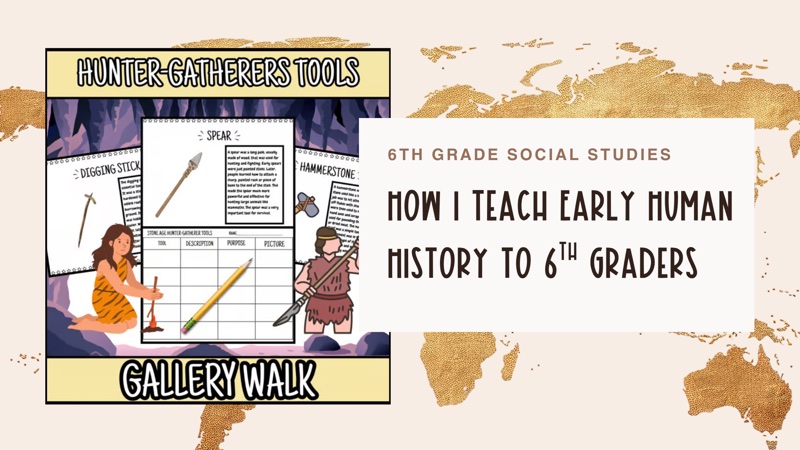
My Nomadic Hunter-Gatherers Tools Gallery Walk includes 10 reading stations about tools used by early humans during the Stone Age. Students rotate through the stations, read about each tool, and record the most important information on their answer sheets.
The gallery walk gives students a chance to move, talk about what they are learning, and examine each tool separately. It also helps them see that early human tools were not random objects. Each one was created to solve a problem, whether that meant hunting animals, preparing food, making clothing, or building shelter.
After the activity, I usually ask students which tool they think was most important for survival. There is not one perfect answer, which makes it a great way to practice using evidence and explaining their thinking.
Add Artifact Analysis
Another simple early humans activity is to show students an image of a Stone Age tool or artifact without telling them what it is.
Have students write down what they notice, what they think the object may have been used for, and what evidence supports their idea. This is a great way to introduce the difference between observations and inferences while also building historical thinking skills.
Students love feeling like archaeologists, and you do not need an elaborate lesson to make it work. Even one artifact displayed on the board can lead to a strong discussion.
Compare Hunter-Gatherers and Early Farmers
Once students understand nomadic hunter-gatherers, the transition to agriculture makes much more sense.
Create a simple comparison between life as a hunter-gatherer and life in an early farming village. Students can think about food, homes, movement, jobs, safety, possessions, and family life.
I also like asking students which lifestyle they would choose. Some immediately pick farming because it seems safer and more comfortable. Others decide that nomadic life might offer more freedom. Requiring them to support their choice with evidence helps them think beyond the idea that newer always means better.
Keep Returning to Adaptation
Early human history includes a lot of important vocabulary, but the larger story is really about problem-solving.
Early humans survived because they adapted to new environments, created tools, learned to use fire, worked together, and passed knowledge from one generation to the next. When students understand that big idea, the individual topics begin to connect.
Activities such as survival challenges, artifact analysis, comparisons, and a hunter-gatherer gallery walk help make early human history more than a textbook chapter. They give students a chance to think, move, discuss, and understand why early human innovations mattered.
And when sixth graders start debating which Stone Age tool was the most important invention, you know they are doing more than memorizing facts. They are beginning to think like historians.
If you introduce geography before prehistory, these beginning-of-the-year map skills activities can help students review the directions, legends, coordinates, and map types they will use throughout the year.